


Day 20 of my 100 Day Novel Challenge
Seriously, writing a book is no joke. After submitting 15,000 words yesterday, I still have 45,000-plus words remaining! If it wasn’t for my association with the Novel Challenge, I’d still be rewriting the first couple of chapters, seeking perfection while moving at a snail’s pace. But there’s a deadline, and I’m determined to meet it. Lots of questions come to mind when writing, such as, how close can composite characters come to resembling your own relatives? And how legitimate is it for you to borrow a real-life experience – in the name of inspiration – and create a solid-gold event in your novel? How to handle issues such as these are rarely taught while earning an English degree, so now I study, practice, learn, and write.
Today, I’m on a Literary Journey, beginning with visiting Monroeville, Alabama, seeking answers to such questions as I look in on the legacies of both Harper Lee and Truman Capote. The two shared a bit of their childhood here during the dusty days of the Depression, literally, as next door neighbors. [Today, Capote’s house is down to foundational remnants, and Mel’s Dairy Dream now sits where Lee’s family home was once located. I know, it’s a lot to take in!]
I’ve wanted to visit this tiny speck of a town since Lee’s Go Set a Watchman was published three years ago this summer. I’ve learned a lot since arriving, though not necessarily what I expected to uncover.
A long time ago as children, their bond offered shelter against the world; many noted they were different from others and appeared to live in their own space where vivid imaginations buffered real life. The two shared a typewriter and writing time, often taking shifts. Reportedly, Truman was the task master, and Harper went along with it.
Their lives, and the people living here in this small town, greatly inspired their work. Lee’s Atticus Finch was inspired by her father A.C. Lee, who was a lawyer, and named Finch after her mother’s family. She used trial transcripts to create the charges against a fictional Tom Robinson as well as her knowledge gained at University of Alabama’s law school for the trial that followed. Scout’s friend, Dill, was inspired by Capote. Even a reclusive neighbor of Lee’s family, Alfred “Son” Boulware, inspired Boo Radley in To Kill a Mockingbird. Boulware is buried not far from Harper and other family members in Pineville/Hillcrest Cemetery here in Monroeville. His family reportedly tried to sue for libel, but Boulware was already deceased.
While some folks here express pride in Nelle Harper Lee’s accomplishments, they may not herald support of her beyond The Novel; on the other hand, they remain effervescent regarding Truman Capote. An older gentleman welcoming visitors to the Monroeville County Heritage Museum said, “She never once came here. Not ever. Not even to see the play.” And neither Harper Lee nor her family members donated items for the museum’s displays.
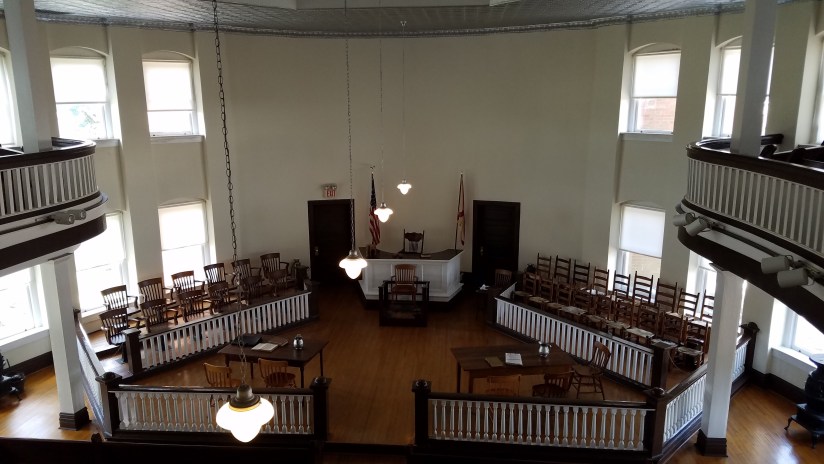
The Old Monroe County Courthouse, yes, the original courthouse that not only inspired the trial scenes with Atticus Finch defending Tom Robinson – but also represented the prototype Hollywood used for the 1962 movie scenes – reflects this response on the part of both authors. Rooms on the second floor of the courthouse celebrate each author’s literary life. Harper Lee’s display is sparse; there are photos and quotations from both newspaper and magazine interviews, as well as a video about the community’s annual play production of the story, but memorabilia is nowhere to be seen.
Not even a typewriter – and I love viewing any literary giant’s typewriter! I’m still thrilled after catching Ernest Hemingway’s Key West typewriter on display in his former Florida home.
In Truman Capote’s rooms at the courthouse/museum, much memorabilia and family history awaits Monroeville visitors including one of his typewriters. Many items were later donated by cousins who helped raise him after Truman’s mother abandoned him. One is reminded that Breakfast at Tiffany’s and “A Christmas Memory” roll with his credits in addition to In Cold Blood.
It’s nothing short of miraculous that this town produced two of the most heralded writers of the 20th century, one a Pulitzer Prize-winning author. According to a museum display, Lee was upset that her novel was considered a liberal endeavor. She responded: “It’s a novel of a man’s conscience, universally in the sense it could happen to anybody, anywhere people live together.” Beyond the talent, though, both Harper Lee and Truman Capote possessed an empathy for the human condition and a perspective stretching beyond their time and place. It is this precious and endearing fact that allows us to continue celebrating their work. So, some of my queries are answered while others remain open-ended.
For example, regarding Go Set a Watchman, there are no answers in Monroeville about whether or not the novel is, in fact, a prequel or a sequel to To Kill a Mockingbird. Reportedly, Watchman was written first and rejected upon the advice that Scout be rewritten as a younger voice. Additionally reported before Watchman was eventually published, Harper Lee proclaimed the novel was a sequel because Scout was a grownup and had a different story to share. But as far as hometown folks like the volunteers working in the old courthouse museum say: “People just wished it never had been published.”
Oh, my.

 LiveLoveTravel.Studio